So much of language is gendered. And, I’m not just talking about pronouns (he, she, they, per, fae, etc.).
English doesn’t have ‘grammatical gender’ like in the case of a slew of other named languages (in Spanish, depending on the adjective, you provide the gender marker of the person or thing being described: the red fox=el zorro rojo, as opposed to, the red foxtress=la zorra roja…okay so foxtress might be made up, but you get the point, hopefully.)
But, so many of the words that we use in our everyday lives are layered with the false dichotomy of a gender binary, e.g. mom/dad, brother/sister, etc. And, yes, there are so-called ‘neutral’ options as well, e.g. parent, sibling, etc. Even the clothing sections at most big box stores are labeled as men’s/women’s/boy’s/girl’s. Infant and toddlers sections are the only gender neutral labels.
So, if you’re writing about a character whose parent has a sibling that doesn’t identify within the false binary, what title do you give them? Or, how about a sibling’s child? Words for these relationships that go beyond a binary haven’t made it into our collective linguistic repertoire (our language toolbox, so to speak) on a large scale yet.
I first heard adrienne marie brown talk about their nibling while discussing family with Toshi Reagon on their podcast, Octavia’s Parables. I can’t remember how adrienne explained it, but if you take the word apart, the n- might come from neice/nephew and -ibling from sibling. I loved it!
When I started writing, Now. Then. To Come, the first book in the Journey Across Genes Saga, I was desperately searching the interwebs for gender inclusive words to describe the relationships in our everyday lived experiences. Luckily, I stumbled upon AGA (A Gender Agenda), an organization whose goal is to raise public awareness of intersex, trans, and gender diversity issues. They have an amazing resource that can be found on their website.
Here are a few examples that I screen grabbed from their site:
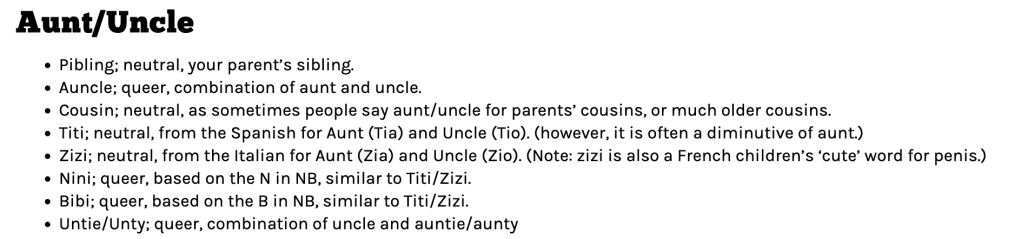
Since coming out to my family as genderqueer and requesting that they use my new pronouns (they, at least for now), I see everyone struggling. I’ll get introduced as “my brother,” and sometimes they’ll correct themselves, “I mean my sib.” Despite the mistakes, I really, truly appreciate their effort! As a race, we humans have a long way to go before the false dichotomy is put to rest for good. And, who has that much time?!
That’s why it’s important for us to write ourselves into the world, and the world of speculative fiction can be an excellent place to do that.
 HOME
HOME 
Leave a comment